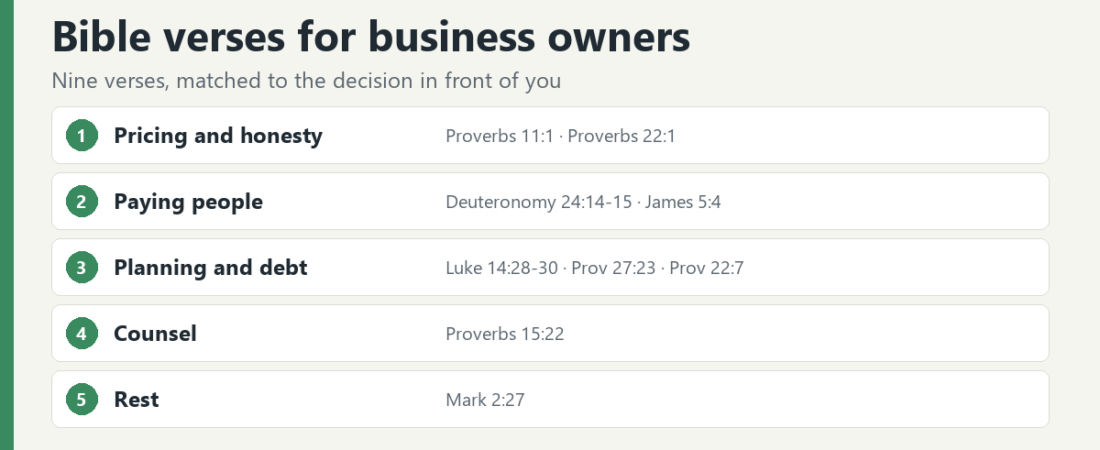
The most useful Bible verses for business owners aren’t the ones on the office wall. They’re the ones you can hold up against a real decision this week: what you charge, how fast you pay people, whether to borrow, when to stop working. Here are nine, grouped by the decision they speak to, with the question each one puts to you.
We quote the World English Bible, a public-domain translation, so you can copy any of these into a handbook, a sign or a team email without asking anyone’s permission. Read them in your own translation too. The wording shifts. The point doesn’t.
Verses for how you price and sell
“A false balance is an abomination to Yahweh, but accurate weights are his delight.”
Proverbs 11:1
A merchant in Solomon’s day could cheat with a scale nobody else could check. Your version is the quote that leaves out the fee everyone pays, the “starting at” price nobody gets, or the renewal rate buried on page four. Ask it this way: if the customer saw everything I see, would they feel cheated? If the answer is maybe, the scale is off.
“A good name is more desirable than great riches, and loving favor is better than silver and gold.”
Proverbs 22:1
This is the verse for the day a big job would cost you a small principle. A good name compounds the same way money does, through referrals and repeat work, and it’s much harder to buy back. We wrote about the decisions that make a business faith-based in practice, rather than on the logo, in what is a faith-based business.
Verses for how you pay the people who work for you
“You shall not oppress a hired servant who is poor and needy, whether he is one of your brothers, or one of the foreigners who are in your land within your gates. In his day you shall give him his hire, neither shall the sun go down on it; for he is poor, and sets his heart on it; lest he cry against you to Yahweh, and it be sin to you.”
Deuteronomy 24:14–15
Same-day pay was the rule for a day laborer who needed that day’s wage to eat. Your payroll runs on a schedule, and that’s fine. The question this verse puts to a small business is narrower: who are you paying late because they can’t afford to complain? The subcontractor on net-60. The freelancer whose invoice sits in a pile. That’s where it bites.
“Behold, the wages of the laborers who mowed your fields, which you have kept back by fraud, cry out, and the cries of those who reaped have entered into the ears of the Lord of Armies.”
James 5:4
James is talking about wages held back by fraud, not slow paperwork. But the line between “cash is tight this month” and “I’m using their money as my float” is thinner than most of us admit. If you’re juggling, our piece on cash flow stewardship for Christian founders is a practical place to start.
Verses for planning, borrowing and counting the cost
“For which of you, desiring to build a tower, doesn’t first sit down and count the cost, to see if he has enough to complete it? Or perhaps, when he has laid a foundation, and is not able to finish, everyone who sees begins to mock him, saying, ‘This man began to build, and wasn’t able to finish.’”
Luke 14:28–30
Jesus uses this picture to talk about the cost of following him, not about business plans. Still, the logic he reaches for is one every owner knows: sit down first, run the numbers, then build. A half-finished expansion is the tower everybody in town can see.
“Know well the state of your flocks, and pay attention to your herds: for riches are not forever, nor does the crown endure to all generations.”
Proverbs 27:23–24
Know your numbers. Not roughly. Which clients make you money, which ones cost you money, and how many weeks you could run if sales stopped tomorrow. A shepherd who couldn’t count his flock wasn’t trusting God. He was guessing.
“The rich rule over the poor. The borrower is servant to the lender.”
Proverbs 22:7
Scripture doesn’t ban borrowing, and plenty of faithful owners use credit well. This verse just names what a loan does: it hands somebody else a say in your decisions. Before you sign, ask what you’d no longer be free to do.
Verses for when you’re tempted to go it alone, or never stop
“Where there is no counsel, plans fail; but in a multitude of counselors they are established.”
Proverbs 15:22
Solo founders are the most likely to skip this one, because there’s nobody down the hall. Counsel can be a mentor, a peer group, an accountant who will tell you no, or an hour listening to another owner talk through the same problem. That last one is why the interviews on Unscripted Small Business exist.
“The Sabbath was made for man, not man for the Sabbath.”
Mark 2:27
Jesus said this to people using the rules as a weapon. It also cuts the other way for an owner who never stops: rest was made for you. If your business can’t survive you taking a day off, that isn’t devotion. It’s a design problem, and we wrote about it in the business you steward versus the one you serve.
How to use these verses without turning them into a slogan
A verse on the wall is easy. A verse that changes a decision is the one that counts. Three ways to make that happen:
- Tie one verse to one recurring decision. Proverbs 11:1 goes next to the quote template. Deuteronomy 24:15 goes on the accounts payable checklist. Read it when you do the task.
- Turn each verse into a question, not a rule. “Would they feel cheated if they saw what I see?” works on a Tuesday. “Be honest” doesn’t.
- Say it out loud to someone. Tell a spouse, a partner or an employee which verse you’re trying to run the business by. It’s much harder to quietly drift from something you’ve said to another person.
None of this guarantees a profitable year, and we’re not going to promise you it does. What these passages offer is a way to make the hard calls in a way you can defend before God and in front of your customers.
Common questions about Bible verses for business owners
A few we hear most often.
What is a good Bible verse for starting a business?
Luke 14:28 is the most practical: count the cost before you build. Proverbs 16:3 is the one most often quoted for a launch: “Commit your deeds to Yahweh, and your plans shall succeed.” Read it next to Proverbs 15:22, which says plans succeed with counsel. Committing your work to God and doing the homework aren’t opposites.
Which Bible verse is about honesty in business?
Proverbs 11:1, on false and accurate weights, is the clearest. Deuteronomy 25 and Leviticus 19 make the same point about honest measures.
Is it okay for a Christian business owner to borrow money?
Scripture doesn’t forbid it. Proverbs 22:7 describes what borrowing does to your freedom, and Luke 14:28 asks you to count the cost first. Talk it through with an accountant and someone who shares your convictions.
Bible verses for business owners: pick one decision this week
Don’t try to apply all nine. Pick the decision you’re dreading this week, find the verse above that speaks to it, and write the question it raises on a sticky note where you’ll make the call.
If you want more of this in practice, our free guides on the downloads page cover getting found, building to last and using AI without losing your soul, all from real interviews with faith-driven founders. Which verse is going on your sticky note?
Scripture quotations are from the World English Bible (public domain), checked word for word on November 17, 2026.