A faith-based business is a for-profit company whose owner lets their faith set the rules for the decisions nobody else sees: what you charge, who you take on, what you will not do for money, and how you treat people when it costs you something. It is not a church, it is not a nonprofit, and it is not a legal category. You will not find a “faith-based” box on an LLC filing.
So what does it actually look like? Two guests from Unscripted Small Business gave better answers than any definition, and neither of them reached for a logo with a cross on it.
What “faith-based business” means, and what it doesn’t
The phrase gets used three different ways, and it helps to pull them apart before you decide whether it describes you.
- A business run by a person of faith. Plenty of these exist and say nothing about it. Faith shapes the owner, and the owner shapes the company.
- A business that tells customers its faith is part of the deal. A Christian counselling practice, a church-supply company, a coach who opens sessions in prayer. The customer is choosing the faith along with the service.
- A faith-based organization. That is usually a religious nonprofit, and it is the sense most grant programs mean.
That last one trips people up. If you searched for faith-based business grants, here is the honest version: the U.S. Small Business Administration says plainly that SBA does not provide grants for starting and expanding a business. Its grants go to nonprofits, resource partners and educational organizations. If your mission is charitable, there are other structures worth a look, and we covered one of them in doing good without waiting for a 501(c)(3).
For everyone else, faith-based is something you do, not something you register.
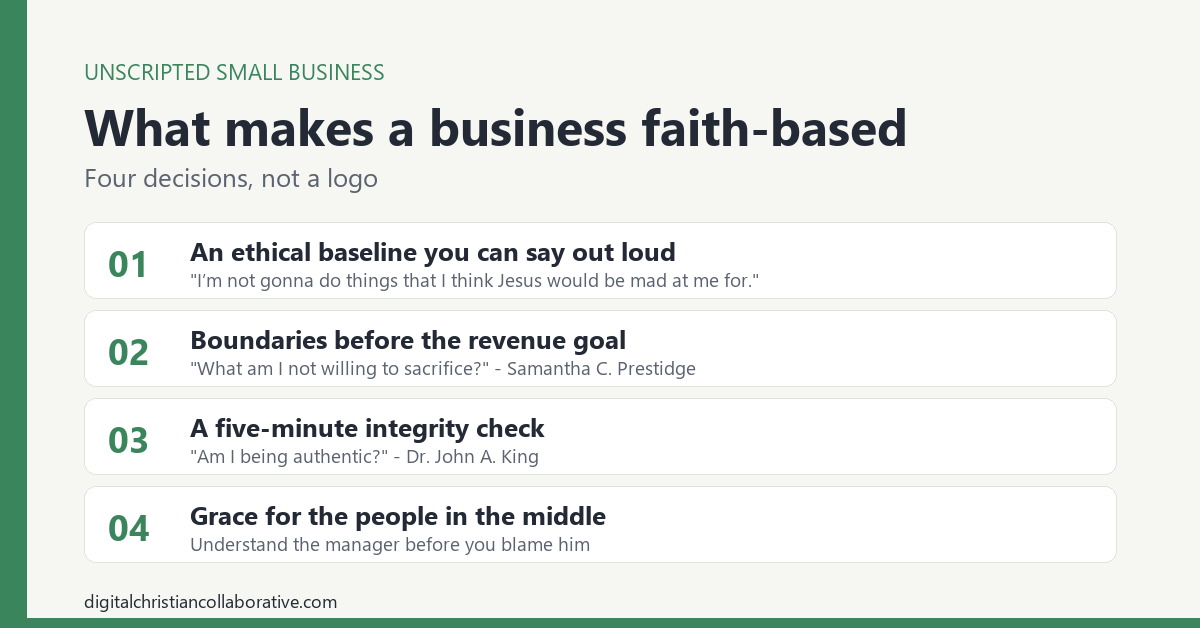
Start with an ethical baseline you can say out loud
Samantha C. Prestidge runs Auxo Business Services, which places U.S.-based virtual assistants with founders. Jeremy opened her interview by asking why anybody should trust her. She did not lead with credentials:
“I think the best answer there is like, I’m not gonna do things that I think Jesus would be mad at me for. So that’s a pretty good ethical baseline in my business.”
— Samantha C. Prestidge, Auxo Business Services, on Unscripted Small Business
It sounds almost too simple. That is the point. A baseline you can say in one sentence is one you can actually check a decision against when a client wants you to cut a corner. A values statement that runs three paragraphs is one nobody reads twice.
Later in the same conversation she pushed back on Jeremy’s theory that return-to-office mandates are driven by bad middle managers, and she did it on the same grounds: “at the beginning I said you could trust me because I love Jesus. OK, so I do love people.” Her ask was to understand the manager stuck in the middle and “give him some grace.” The baseline did not just stop her from doing wrong. It changed how she argued.
Set your boundaries before you set a revenue goal
Here is where a faith-based business actually shows up on a spreadsheet. Samantha admits she used to build every decision around a bigger number:
“I want to live this type of lifestyle. I want to have this time with my two kids. I want to have this time with my husband. What am I not willing to sacrifice in order to build my business?”
— Samantha C. Prestidge
Once she knew the answer, the revenue target got re-set inside it rather than the other way round: “So I could still build a seven figure awesome business, maybe it just takes me a little bit longer and that’s something I’m okay with.”
That order matters. Most founders set the number first and then discover what it cost them. If you believe your family and your health are a trust you were given, you write those down first and let the growth plan fit around them. We dug into the money side of this in cash flow stewardship for Christian founders.
Run a five-minute integrity check before the calendar starts
Dr. John A. King rebuilt his life and his business after a collapse he calls “Johnageddon.” He now runs a performance-mindset program and teaches what he calls the three-by-five rule: three things a day, five minutes each. One of his three is an integrity check, and he described exactly how he does it:
“I’m a Christian man, so I do it often around the word with a cigar and a coffee. I sit and I meditate. Prayer is an aspect of that. And then I ask myself integrity questions. I look at myself. Am I being authentic? Are there any things that I’m engaged in or have been engaged in that aren’t true to myself?”
— Dr. John A. King, on Unscripted Small Business
The question he adds next is the useful one for a business owner. He asks whether there are appointments coming up “where I’ve got a different agenda than just turning up as me.” Read your calendar for today with that question. If a meeting only works because you are going in with a hidden angle, you have found the decision your faith is supposed to be making.
He is also blunt about the opposite failure. “I can have tremendous success as a businessman and have bankrupted my emotional relationships,” he said. For him, “the purpose of being an entrepreneur is to give myself freedom to be present in those things that are really my priority.”
What this looks like on a Tuesday
None of this needs a mission statement or a new logo. It needs a few habits you can actually see:
- Write your baseline in one sentence. Samantha’s is fourteen words. Yours can be shorter.
- List what you will not sacrifice before you set this year’s revenue goal, then size the goal to fit.
- Do the integrity check before you open email. Five minutes, the questions above, and a look at today’s calendar.
- Turn down the work that fails the check, including the well-paid work. That is where the label stops being a label. See serve first, sell second for two consultants who do it.
- Give grace to the people stuck in the middle, your own staff included, before you decide they are the problem.
What the label won’t do for you
Calling your company faith-based does not make it one, and it can cut against you. Some customers will choose you for it. Some will quietly go elsewhere. And the moment you say it out loud, every late invoice and every broken promise gets read against it. That is a higher standard, not a marketing angle.
We can’t tell you that running your business this way makes more money. Nobody in these interviews claimed it does, and we haven’t measured it. What both guests described is a business they could live with, built on decisions they could defend.
So here are the questions worth sitting with. What is your one-sentence baseline? What did you sacrifice last quarter that you never agreed to give up? Is there a meeting on your calendar this week you are walking into with a different agenda than just turning up as you? If you can answer those, you already know whether yours is a faith-based business, whatever it says on the sign.
Quotes are verbatim from the raw Riverside transcripts of Unscripted Small Business, trimmed only for false starts. More at Digital Christian Collaborative and Unscripted Small Business.